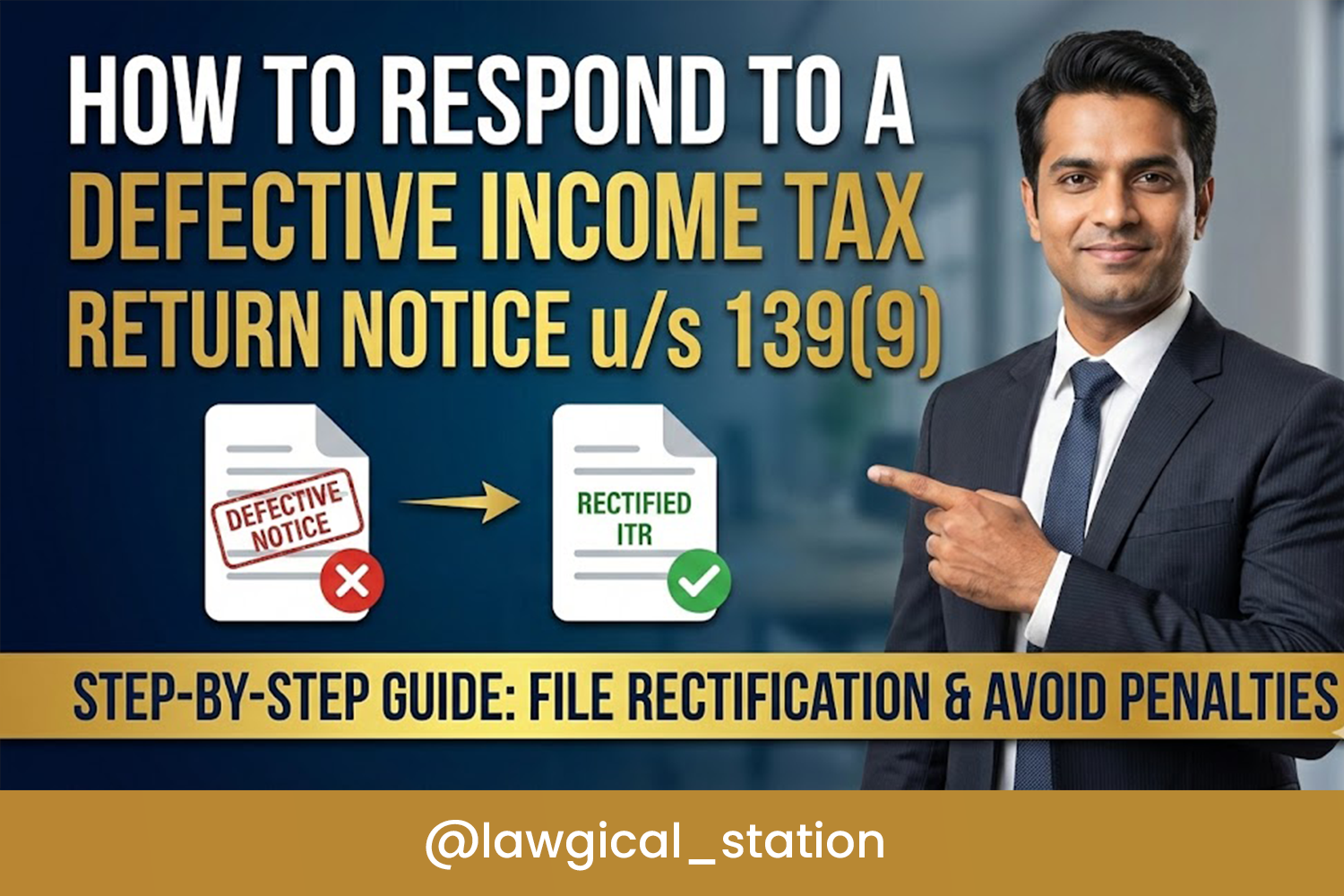
A defective return notice under Section 139(9) is issued when the Income Tax Department identifies errors or inconsistencies in your filed Income Tax Return (ITR). This notice acts as a warning mechanism, giving taxpayers an opportunity to correct mistakes and ensure accurate reporting before facing penalties or other consequences.
What is a Defective Return Notice?
What is a Defective Return Notice u/s 139(9)?
A defective return occurs when the Income Tax Department detects errors, omissions, or inconsistencies in your filed ITR. These could include missing information, conflicting details compared to data available with the department, incorrect basic details, or mistakes in tax calculation.
Under Section 139(9) of the Income Tax Act, 1961, the department issues a notice to give you a chance to correct these mistakes and ensure your ITR reflects accurate and complete information.
How is the Defective Return Notice Delivered?
The Income Tax Department sends the notice u/s 139(9) to your registered email ID
The email subject will be: 'Communication under section 139(9) for PAN [Your PAN] for the Assessment Year [AY]'
The defective return notice is attached as a password-protected PDF
Password format: PAN in lowercase followed by date of birth in DDMMYYYY format
Example: If PAN is MNOPQ1212C and DOB is 12/10/1987, password is: mnopq1212c12101987
Response Time Limit
Taxpayers have 15 days from the date of issue of the notice to respond. If you need more time, you can request an extension from the Assessing Officer.
Common Reasons for Defective Return Notice
1. Incomplete Income Tax Return
If your ITR lacks necessary details in annexures, statements, or mandatory columns, such as income from all sources not being mentioned, it may be marked as defective.
2. Missing Tax Payment Information
If taxes have been paid but their details are omitted in the ITR, including information about TDS, TCS, advance tax, or self-assessment tax, a notice may be issued.
3. TDS and Income Mismatch
When TDS is claimed but the corresponding income is not offered for tax in the ITR. For example, if you have earned interest income from term deposits and tax has been deducted by the bank, both interest income and tax deducted should be reported in the ITR.
4. Income Tax Audit Concerns
If an audit is required under section 44AB, the complete audit report including profit and loss account, balance sheet, and auditor's report should be submitted. Incomplete or missing audit reports can trigger a defective return notice.
5. Presumptive Taxation Inaccuracies
In cases of presumptive taxation, providing inaccurate computation of presumptive income, non-disclosure of relevant details, or mismatched gross receipts can lead to a defective return notice.
6. Tax Payment Discrepancies
If taxes are partially paid or the paid amount doesn't align with the tax liability in the ITR, a defective return notice may be issued.
7. Incorrect Details in ITR
Filing an ITR with incorrect details regarding turnover, income limits, or inappropriate reporting for a specific head of income can lead to a defective return notice.
8. Name Mismatch
When the name mentioned in the ITR does not match the name on the PAN card, the return may be marked as defective.
How to Respond to Defective Return Notice u/s 139(9)
Step 1: Understand the Defect
Carefully read the notice to understand the specific defect or error pointed out by the Income Tax Department. The notice will clearly mention what needs to be corrected.
Step 2: Gather Required Documents
Collect all relevant documents such as Form 16, Form 26AS, bank statements, investment proofs, and any other documents needed to rectify the defect.
Step 3: Revise Your Return
Log in to the Income Tax e-filing portal and revise your return addressing all the defects mentioned in the notice. Make sure to correct all errors and provide complete information.
Step 4: Submit the Revised Return
After making corrections, submit the revised return within 15 days. The system will generate a new acknowledgment number for the revised return.
Consequences of Not Responding
If you fail to respond to the defective notice within the 15-day time limit, the return already filed would be treated as invalid. This results in:
Late filing penalty under Section 234F
Delay in processing of refund
Denial of carry-forward of losses
Interest on tax liability under Section 234A, 234B, and 234C
Potential scrutiny or assessment proceedings
Important Points to Remember
You cannot file a fresh return as a response to the notice - you must revise the existing return
The response must be submitted online through the e-filing portal
You can authorize another person (CA or tax professional) to respond on your behalf
Keep all supporting documents ready before revising the return
Ensure all corrections are made accurately to avoid further notices
Seeking Professional Help
If you find it challenging to understand or respond to the defective return notice, it's advisable to seek help from a qualified Chartered Accountant or tax professional. They can help you identify the issues, gather necessary documents, and file a proper response within the deadline.