Recently, many taxpayers have received scrutiny notices asking for highly detailed personal expense breakups — from rice and spices to haircuts, perfumes and restaurant bills. These queries feel intrusive, but they follow legal powers under Section 142 of the Income Tax Act. If you get such a notice, immediate action is essential: incorrect or late replies can lead to estimated additions (sometimes assumed expenses like ₹10 lakh) → resulting tax, interest and penalties. This article gives you a practical, step-by-step plan: what to do now, how to prepare a reply, exact proofs to collect, and a ready template you can copy and send.
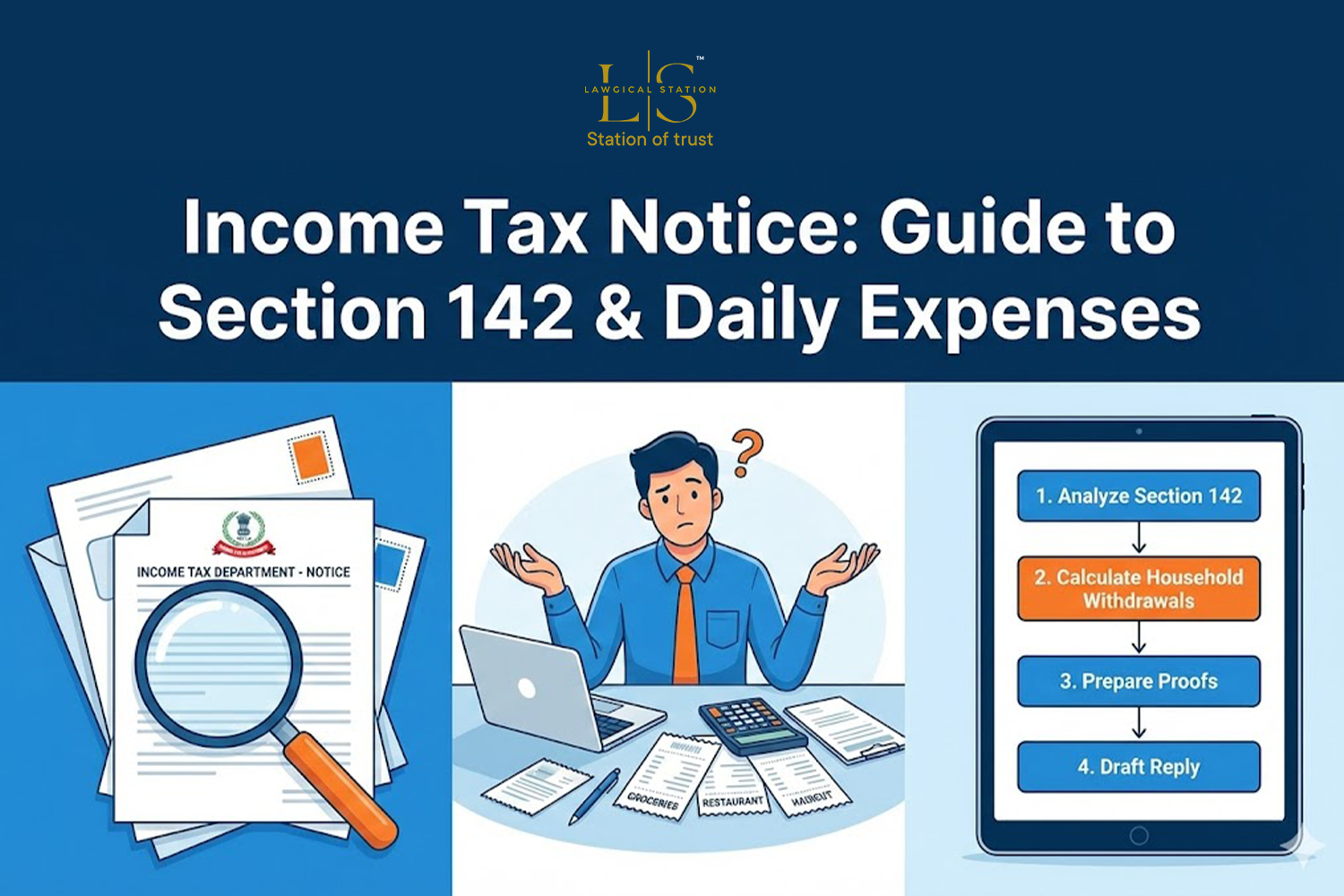
Quick Overview: What is a Section 142 Notice?
Section 142(1) allows the Income Tax Officer (ITO) to ask for information or documents to verify your return or income. Notices under Section 142 are part of scrutiny assessment — they are not always accusations, but you must respond accurately and promptly.
Why the Tax Department Asks About Daily Expenses
The tax department compares: Declared income (tax returns, salary, business income) vs Spending pattern visible from bank statements, UPI logs and card transactions. If spending appears higher than declared income, or personal expenses are not reflected consistently, authorities may suspect undisclosed cash income and ask for details.
First Actions When You Receive the Notice (Do This Within 7 Days)
1. Read the notice carefully. Note deadline, specific items requested and the assessment year. 2. Don't panic. Most notices are routine; a clear reply solves them. 3. Collect basics immediately: PAN, last 3 years' ITR, bank statements, UPI statements, business books (if any). 4. Contact your Chartered Accountant (CA) or tax professional immediately. If you don't have one, prepare the documents described below and consider hiring a tax adviser. 5. If deadline is very near, request time extension with a short formal letter/email (ITO usually grants reasonable time).
Documents & Proofs to Collect (Complete Checklist)
Collect both digital and physical proofs where possible. Keep scanned copies and organize in folders by category & month.
Essential Documents
Bank statements (all accounts) for the period requested; UPI transaction history / app statements (Google Pay, PhonePe, Paytm); Credit/debit card statements; Salary slips / Form 16 / business invoices; Rent receipts or rent agreement (if applicable).
Expense Proofs (As Asked in the Notice)
Grocery bills / supermarket invoices (monthly); Utility bills: electricity, gas, water, internet; Restaurant / food delivery bills / app invoices; Salon / haircut invoices or monthly summary (if available); Perfume / cosmetics bills; Gift receipts, event invoices, social gathering bills; School / tuition fee receipts; Insurance premium receipts (health, life, vehicle); Car run/repair bills, fuel receipts; Medical bills & prescriptions (if applicable).
Other Supporting Proofs
Affidavit (if some expenses were paid in cash and no receipts exist) — signed and dated with explanation; Bank letters showing cash withdrawals, if used for household expenses; Business accounting entries (if you recorded any personal expenses in business books); Letters from family members/household for shared expenses (if needed).
How to Calculate "Household Withdrawals" — Simple Method with Example
Many notices ask for household withdrawals — the portion of withdrawals used for household consumption.
Common Formula Approach (Simple & Defensible)
1. Total Cash Withdrawals (TW) during the period — sum of ATM withdrawals + cash withdrawals from bank. 2. Business Cash Withdrawals (BW) — cash withdrawals directly used for business (evidenced by business purchases, petty cash ledger). 3. Household Withdrawals (HW) = TW − BW
Example
Total cash withdrawals in the year (TW) = ₹3,00,000. Business cash withdrawals (BW) supported by invoices = ₹1,50,000. Household Withdrawals (HW) = ₹3,00,000 − ₹1,50,000 = ₹1,50,000. Now compare HW with your bank UPI/card household spending record. If HW > recorded household spending, prepare an explanation (e.g., cash purchases from neighbourhood kirana, cash payments to domestic help, gifts).
Tip: Prepare a months-wise summary (Month | Cash Withdrawals | Business Portion | Household Portion | Bank/UPI Household Spending).
Practical Reply Strategy — Do Not Over-Explain, Be Factual
Be factual and concise. Provide a covering letter that explains how you computed household withdrawals and why any mismatch exists. Attach evidence in a clear order (index your documents: Doc 1 – bank statement Jan, Doc 2 – grocery bills Feb, etc.). If something is missing, give a brief reason and attach an affidavit if necessary. Never fabricate documents. If you don't have receipts, explain with reasonable details and backup by bank cash withdrawal logs.
Ready Section 142 Reply — Copy & Fill Template
To: The Income Tax Officer, [Ward / Circle / AO Address]
Subject: Reply to Notice dated [DD/MM/YYYY] under Section 142(1) for Assessment Year [YYYY-YY] — PAN: [XXXXX]
Respected Sir / Madam,
In response to the notice dated [DD/MM/YYYY] seeking clarification regarding monthly personal expenses, I submit the following:
1. Basic details: Name: [Your Name], PAN: [XXXXX], ITR filed for AY: [YYYY-YY] on [Date].
2. Bank & digital transactions: I have attached bank statements for all accounts (Annexure A) and UPI / card statements (Annexure B).
3. Household withdrawals calculation: Total cash withdrawals during the year: ₹[TW]. Business withdrawals (supported by invoices): ₹[BW]. Household withdrawals thus: ₹[HW]. (Computation sheet attached as Annexure C).
4. Expense breakup: Monthly household spend (groceries, utilities, food, grooming etc.) as per submitted bills / receipts is attached (Annexure D). Where no formal receipt existed (local kirana / vegetable purchases), I have provided cash withdrawal references and an explanation affidavit (Annexure E).
5. Other supporting documents: Salary slips/Form 16/business books/invoices/insurance receipts — Annexure F.
6. Declaration: I declare that to the best of my knowledge these details are true & correct. I request you to consider the attached documents and oblige.
Place: [City] | Date: [DD/MM/YYYY] | Signature: [Your Signature] | Name: [Full Name] | Contact: [Phone & email]
Sample Annexure Index (How to Present Attachments)
1. Annexure A — Bank statements (Jan–Dec YYYY) — Account 1 (Page1-10)
2. Annexure B — UPI / Card statements (monthly screenshots)
3. Annexure C — Household withdrawal computation sheet (Excel snapshot)
4. Annexure D — Grocery / Restaurant / Salon bills (month wise)
5. Annexure E — Affidavit explaining cash purchases (if necessary)
6. Annexure F — Salary slips / Form 16 / Business invoices
7. Annexure G — Rent agreement & rent receipts (if applicable)
Common Red Flags to Avoid (So You Don't Get Noticed)
Mixing personal expenses in business accounts without entries. Showing very low cash withdrawals but a high lifestyle. No supporting bills/receipts while spending appears high. Sudden unexplained large purchases. Not filing returns or late filing.
Timeline & Follow-Up — What to Expect After You Submit
Acknowledge receipt of your reply (e-file or physical). Officer may accept or ask for further documents/clarification. If satisfied, assessment proceeds. If not, they may estimate and propose additions — then you can file reply/appeal steps. Keep copies of everything — e-mail confirmations, courier receipts.
When Should You Consult a Chartered Accountant or Tax Lawyer?
If the estimated addition proposed by ITD is large (e.g., several lakhs). If you lack adequate supporting proof for major cash flows. If the officer proposes penalties or framing of concealment. If you prefer a professional to draft and send the reply and represent before the officer.
Frequently Asked Questions
Q1: Can ITD really ask about groceries and haircuts?
Yes. Under Section 142, ITD can ask for proof of income and expenses.
Q2: What if I paid in cash and don't have bills?
Provide cash withdrawal evidence, explain reason in affidavit and provide any alternate proof (vendor SMS, bank ledger, neighbor statements).
Q3: Will everyone get such a notice?
No. Notices usually target mismatch signals — lifestyle vs declared income.
Q4: Is it okay to request more time to reply?
Yes. You can write to the concerned officer requesting an extension — usually granted for valid reasons.
Final Words — Be Prepared, Not Panicked
The exponential rise of digital payments has made spending patterns easier to analyse — which is why matching your declared income and lifestyle matters. Clear records, basic bookkeeping and timely professional advice solve most issues. Take action now: gather bank statements, UPI records and receipts for the period mentioned in your notice. Draft a clear, factual reply using the template above and consult your CA if the numbers are large.