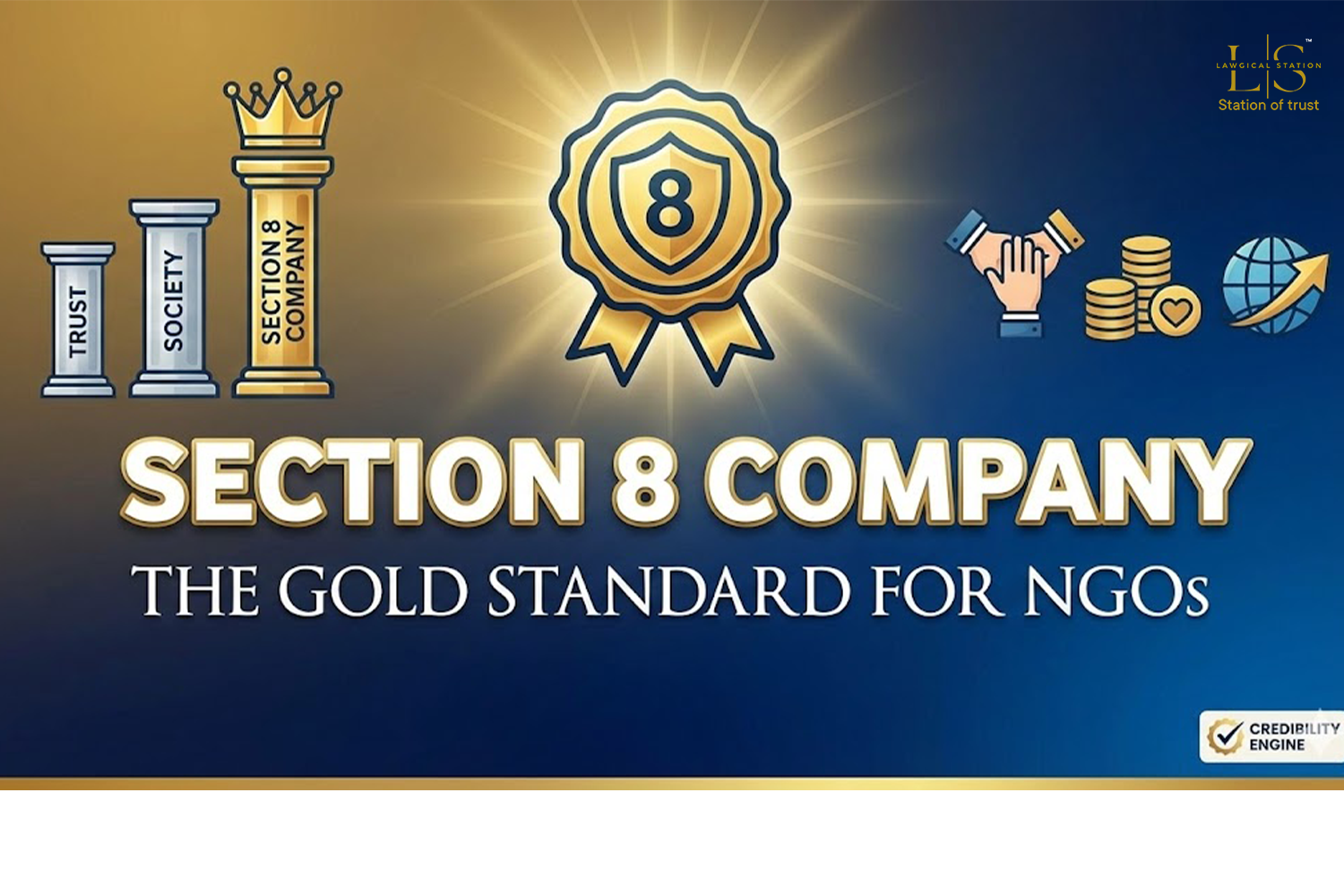
If your mission is non-profit—promoting art, education, social welfare, or research—you have three main legal options: a Trust, a Society, or a Section 8 Company.
Choosing a Section 8 Company isn't just picking a form; it's choosing the option built for scale, national operation, and maximum financial trust. It's the NGO structure that major foundations, corporate CSR wings, and international donors look for first.
Why? Because it operates under the stringent Companies Act, 2013, giving it the highest level of accountability, transparency, and legal rigor.
Part 1: The NGO Dilemma (Why Section 8 Came into Existence)
Imagine a scenario in which a philanthropist wants to donate ₹1 Crore for a national education project. They want to ensure their money is managed transparently and goes directly to the cause.
Old NGO forms (Trusts/Societies): These are regulated by state-specific laws, often lack public data, and historically have less stringent compliance requirements, which leads to lower perceived trust.
The Problem: Large-scale donors (especially corporates and foreign entities) need centralized, nationally uniform, and transparent compliance.
The Section 8 Company was the solution. It brings non-profit work under the robust framework of the MCA, ensuring that every transaction, every director, and every annual report is filed digitally, creating a verifiable public record. This structural integrity is the biggest reason for its high credibility.
Real-Life Example: Major corporate CSR wings like the Infosys Foundation and Reliance Foundation operate as Section 8 Companies because the structure is internationally recognized, legally solid, and instantly trustworthy.
The Structural Advantage: Why Section 8 Tops the Charts
The Section 8 Company is essentially a Private Limited Company but with one massive condition: It cannot distribute profit. All income must be ploughed back into the company's stated charitable objectives.
Comparison: Section 8 Company vs Trust/Society
| Feature | Section 8 Company (NGO) | Trust/Society (NGO) |
|---|---|---|
| Governing Law | Companies Act, 2013 (Central) | State Trust Acts / Societies Registration Act (State) |
| Credibility & Trust | Highest. Regulated by MCA; high public disclosure. | Moderate to Low. Less public data, rules vary by state. |
| Funding Preference | Most Preferred for large grants, corporate CSR, and FCRA (Foreign Contribution). | Less preferred for major national/international funding. |
| Name Suffix | Not required to use "Pvt Ltd" or "Ltd." | Not Applicable. |
| Audit Requirement | Mandatory Annual Audit. | Conditional (often turnover-based). |
The Core Benefits
Separate Legal Entity & Limited Liability: Just like a Pvt Ltd, the company is separate from its founders. Their personal assets are protected from the company's debts.
Tax Exemptions (for the Company): After registering with the Income Tax Department under Section 12A, the company's income is exempt from tax, provided it is used entirely for the stated social objectives.
Donor Tax Benefits (The 80G Magnet): This is the game-changer! Once the Section 8 Company obtains Section 80G registration, donors can claim a tax deduction on the amount they donate. This makes your organization instantly more attractive to individuals and corporations.
Zero Stamp Duty: Section 8 Companies are exempted from paying stamp duty on the Memorandum of Association (MoA) and Articles of Association (AoA), saving on initial setup costs.
The Compliance Reality: Pitfalls That Cost Your Mission
The high credibility of a Section 8 Company comes with strict, non-negotiable compliance. The MCA is always watching to ensure you aren't using the NPO status for personal gain.
1. The Single Fatal Rule: No Profit Distribution
The Rule: A Section 8 Company CAN generate profits (e.g., from fees for services, selling merchandise, or investment income), but this profit must be re-invested 100% into the charitable objectives.
The Consequence: If the government finds evidence that profits are being distributed as dividends or benefits to members/directors, the license can be revoked, and the directors can face prosecution.
2. The Director-Remuneration Trap
The Rule: Directors can only be paid a salary or compensation if it is a reasonable rate for professional services rendered and is explicitly approved by the Board.
The Practical Mistake: Paying excessive salaries or high 'consultancy fees' to a director's relative without transparent justification can be flagged as indirect profit distribution, risking the license. Keep salaries fair and market-rate.
3. The Audit Mandate
The Rule: The Annual Audit and filing of the Annual Return (MGT-7/7A) and Financial Statements (AOC-4) with the MCA is mandatory every year, regardless of turnover.
The Consequence: Non-filing leads to the same heavy daily penalties (₹100/day) as a normal Pvt Ltd, which can quickly cripple a young NGO's budget.
Who Should Choose a Section 8 Company?
A Section 8 Company is the right choice when your goal is not just local impact, but national reach, long-term stability, and major funding.
Educational Institutions: (Schools, Colleges, Research Bodies) operating on a non-profit basis.
Healthcare Initiatives: (Hospitals, Clinics) offering subsidized services.
Large-Scale NGOs: Organizations planning to receive foreign funding (FCRA) or large corporate grants (CSR), as the credibility is essential for these sources.
Foundations: Entities established by corporations or wealthy families for structured, long-term charity work.
Post-Incorporation Checklist (Your NGO's Financial Foundation)
Getting the Section 8 license from the MCA is just the start. The real work is securing your tax exemptions to maximize every rupee donated.
| Priority Task | Goal & Form | Why it's Critical |
|---|---|---|
| Tax Exemption | Apply for Section 12A registration. | Makes the company's income tax-free (if funds are applied to the cause). You must do this. |
| Donor Benefit | Apply for Section 80G registration. | Allows your donors to claim tax deductions. This is the primary fundraising tool. |
| Bank Account | Open an account in the company's name. | Mandatory for all transactions and must be completed to file the INC-20A Commencement of Business. |
| FCRA | Register under the FCRA Act, 2010. | Mandatory if you plan to receive any donation from a source outside India. |
The Final Word
A Section 8 Company is your official entry ticket to the world of serious, large-scale philanthropy. It requires more setup work and strict ongoing compliance than a Trust, but in return, it grants you the highest level of financial integrity and donor trust—tools essential for any organization aiming to create lasting social change.